Payout Speed Statistics: How Fast Money Actually Moves
Regulated instant transfers must clear in ten seconds. Most consumer payouts still quote 24 hours. What the published withdrawal windows measure, and what sets the floor.

Payment speed has quietly become the metric consumers use to judge a platform. Not price, not catalogue — how long the money takes to arrive once they ask for it.
The rails have moved faster than most of the businesses sitting on top of them. Since 9 October 2025, a payment service provider anywhere in the euro area has been obliged to make an instant euro transfer available to the payee, or reject it, within ten seconds — day, night, weekend, no exceptions. Canada is next in line. Payments Canada confirmed in June 2026 that the Real-Time Rail by-law comes into force on 24 August 2026, ahead of a phased launch in the fourth quarter.
What the rails can already do
Canadians made 22.5 billion retail payment transactions worth $12.2 trillion in 2024, and 86% of that volume was already digital. The fastest-growing category was online transfers — the bucket that contains Interac e-Transfer — up 175% in volume and 219% in value over five years. E-commerce accounted for $77 billion of transaction value, or 6% of retail sales.
That growth is where consumer expectation comes from. A person who can move money to a friend in under a minute, at midnight, has an obvious reference point for how long any other payout should take.
What the fast payout casinos Canada rankings actually measure
Online gaming is one of the very few consumer categories where the withdrawal window is advertised as a headline feature rather than buried in the terms. The comparison sites in that market rank operators on payout speed the way a price-comparison site ranks on price, which makes it a usefully public test case for everything above.
A Canadian guide carried by National Post does exactly that, and their published findings put the quickest verified e-wallet payout at about an hour, with most of the ranked sites quoting 24 hours for a verified withdrawal, 24 to 48 hours for a bank wire, and several days for a card. Minimum withdrawals across the list run from $5 to $20.
Two things are worth noting before anyone quotes those figures. They are advertised windows, not measured ones: operator commitments collected by a commercial review site, with no published distribution behind them. And they describe verified accounts using each operator’s fastest available method — which is the best case, not the typical one.
| Method | Advertised window | What sets the floor |
|---|---|---|
| Instant euro transfer (SEPA area) | 10 seconds | Regulation |
| E-wallet payout, verified account | About 1 hour | Operator approval queue |
| Interac withdrawal, verified account | Within 24 hours | Approval plus bank messaging |
| Bank wire | 24 to 48 hours | Batch settlement on bank hours |
| Card withdrawal | 3 to 5 days | Card scheme return path |
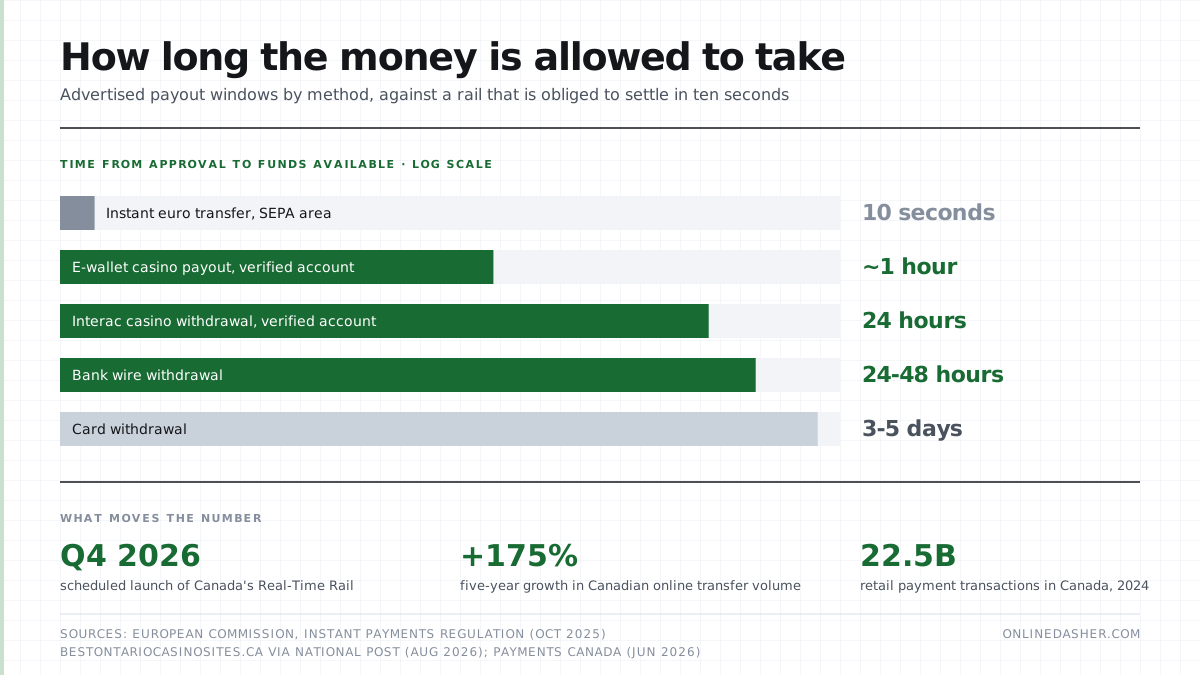
The delay is verification, not the rail
Every quoted window in that table starts at approval, and approval is where the time actually goes. The first withdrawal on a new account triggers identity verification; the guide says so itself, noting that a first cashout still waiting on identity checks takes longer than the figures shown. After that, repeat withdrawals move at the speed of the method.
This is the part that a faster rail does not fix. The Real-Time Rail will settle a Canadian payment in seconds, 24/7, from Q4 2026. It will do nothing about a compliance queue that opens at nine on a Monday. Speed claims that rest on the rail rather than on the process will get shorter on paper and stay the same in practice — the same distinction we apply to any vendor-supplied figure on our methodology page.
What these numbers cannot tell you
There is no independent measurement of consumer payout times in this market. No regulator publishes them, no operator discloses a median, and no dataset shows the tail — the share of withdrawals that miss the advertised window, and by how much. What exists is a set of self-reported best cases, ranked.
The honest reading is narrow: payout speed is now competed on openly in at least one consumer category, the published windows cluster at 24 hours, and the fastest of them are already an order of magnitude slower than what the payment rails underneath will shortly be required to do.
Related reading
- TikTok shopping statistics — another market where a headline figure hides the distribution underneath it
- Starbucks customer loyalty statistics — what retention actually costs when the reward is the product
- Product photography statistics — the other place where a promise made at checkout is tested after it
- All research — everything currently on record
- How we source figures — what we will and will not publish
Frequently asked
10 entriesHow fast is an instant payment supposed to be?
Ten seconds. Under the EU Instant Payments Regulation, a payment service provider in the euro area must make the funds available to the payee, or reject the transfer, within ten seconds of receiving the order — at any hour, on any day.
When does Canada get the same thing?
The Real-Time Rail is scheduled for a phased launch in the fourth quarter of 2026. Payments Canada confirmed in June 2026 that the RTR by-law and rules come into force on 24 August 2026. Receiving is mandatory for participants from launch; consumer-facing sending is initially optional.
Does a faster rail mean faster payouts?
Not on its own. The rail sets the floor, not the total. A payout that waits two days in an approval queue and then settles in ten seconds still took two days from the customer's point of view.
What withdrawal times do gaming sites actually advertise?
The Canadian guide carried by National Post puts the fastest verified e-wallet payouts at about an hour, Interac withdrawals within 24 hours, bank wires at 24 to 48 hours, and card withdrawals at several days. Those are advertised windows for verified accounts using each operator's fastest method.
Are those figures independently measured?
No. They are operator-stated windows collected and ranked by a commercial review site. Treat them as what operators commit to publicly, not as observed median payout times. Nobody publishes the distribution.
What actually causes a slow payout?
Identity verification, almost always on the first withdrawal. Once know-your-customer checks clear, repeat withdrawals move at the speed of the payment method. The guide itself notes that a first cashout still requiring verification will take longer than the quoted figures.
Why does the payment method change the answer?
Different methods use different rails. An e-wallet transfer is a book entry at the wallet provider. Interac e-Transfer moves through bank messaging. A card withdrawal travels the card scheme's return path, which was built for refunds rather than payouts. A wire settles in batches on bank hours.
Is payout speed a meaningful competitive metric?
It is where the rest of the offer is comparable. When price, catalogue and terms converge, the withdrawal window is one of the few remaining differences a customer experiences directly — which is why it gets advertised at all.
How much of Canadian payment volume is already digital?
Digital payments were 86% of total payment volume and 77% of total value in 2024, on 22.5 billion retail transactions worth $12.2 trillion.
Which payment type is growing fastest in Canada?
Online transfers, the category that includes Interac e-Transfer. Volume grew 175% and value 219% over the five years to 2024 — faster than any other method Payments Canada tracks.
Sources
5 referenced- European Commission
· Official
New EU rules make instant euro payments faster and safer
Published 2025-10-10 · last verified 2026-09-18 - Payments Canada
· Official
Critical milestone achieved: By-law and rules approved for Canada's Real-Time Rail
Published 2026-06-30 · last verified 2026-09-18 - Payments Canada
· Research
Canada reaches $12.2 trillion in payment transactions in 2024
Published 2025-10-02 · last verified 2026-09-18 - Bestontariocasinosites.ca
· Industry guide
Fast payout online casinos Canada, published by National Post
Published 2025-10-15 · last verified 2026-09-18 - US Census Bureau
· Official
Quarterly Retail E-Commerce Sales, First Quarter 2026
Published 2026-05-18 · last verified 2026-09-18