Amazon Alexa Statistics: Devices Sold, Real Users and Alexa+ Data
Amazon Alexa statistics from Amazon's own disclosures: 600 million devices, what that figure does and does not mean, and why voice commerce data stays missing.

Amazon says there are “over 600 million Alexa devices out there today”. It is the most quoted figure in this subject and the most frequently misread: it counts devices, not people.
That distinction carries most of what is interesting about Alexa statistics. The installed base is genuinely enormous. What that base does commercially has never been disclosed by anyone in a position to know.
What Amazon actually says
Amazon’s own numbers, taken from its own material rather than from secondary coverage:
| Figure | Amazon’s wording | Date |
|---|---|---|
| 600M+ | “There are over 600 million Alexa devices out there today” | Alexa+ material, updated 2026 |
| 500M+ | “they’ve now purchased well over half a billion Alexa-enabled devices” | May 2023 |
| 35% | “use of Alexa increased 35 percent last year” | May 2023, describing 2022 |
| $19.99/mo | “Alexa+ costs $19.99 per month” | Feb 2025 |
| Free | “all Amazon Prime members get it for free” | Feb 2025 |
Note what is present and what is not. Device counts: published. Price: published. Users, households, interactions per device, and anything about purchasing: absent.
The growth rate nobody quotes
Put the two device figures on a timeline and the picture changes.
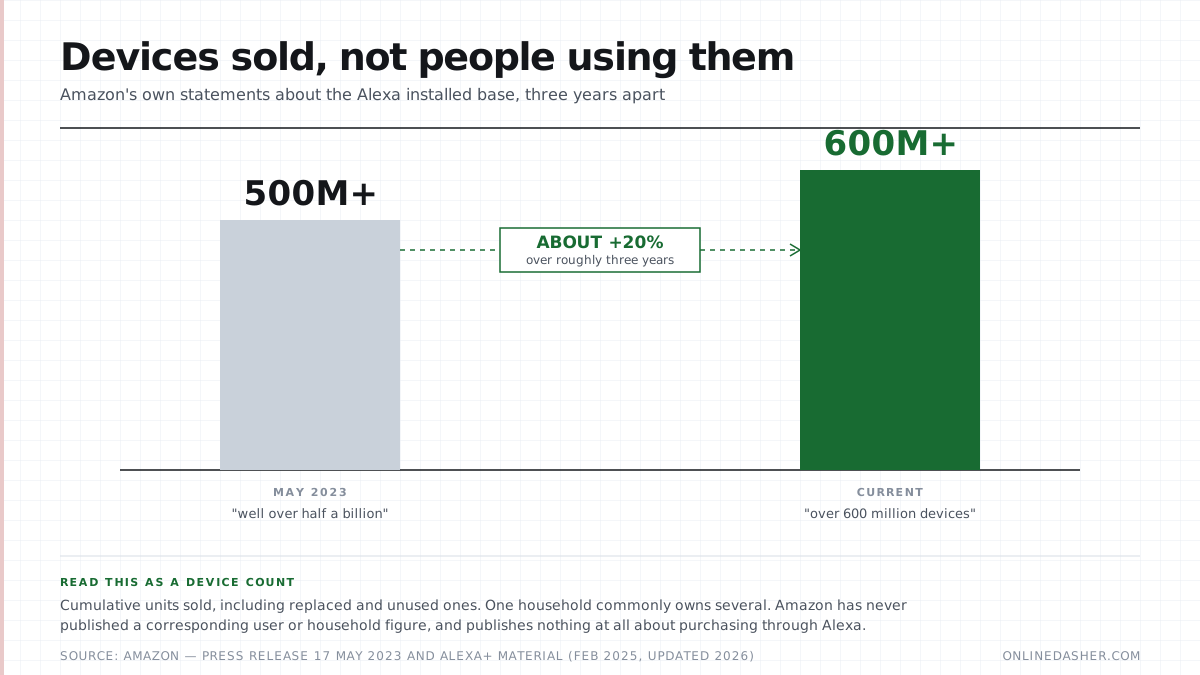
Amazon announced “well over half a billion” devices in May 2023. Its current material says “over 600 million”. Both numbers are rounded and neither is dated precisely, but the implied movement is roughly 20% over about three years — call it 6 to 7% a year.
For a product category still routinely described as exploding, that is modest. It is the growth profile of a mature accessory, not an emerging platform. And it is visible only if you compare Amazon’s own statements across time, which is why the 600 million figure usually appears without context.
What counts as an “Alexa device”
The phrase does more work than it appears to. Amazon’s 2023 milestone was explicitly about “Alexa-enabled devices”, a category that extends well past the Echo speakers most people picture.
It includes Amazon’s own hardware across several product lines — smart speakers, smart displays, streaming sticks and set-top devices, soundbars, wearables — and it includes third-party products from other manufacturers that ship with Alexa built in: televisions, headphones, cars, thermostats, light switches.
Two consequences follow, and both cut against how the figure is usually deployed.
Many of these are not primarily voice products. A television with Alexa built in is bought to watch television. Counting it toward an assistant’s installed base is defensible as a capability count and misleading as an adoption count.
The purchase decision often had nothing to do with Alexa. Nobody selects a thermostat on assistant compatibility the way they select a phone on its operating system. Attributing intent to these units overstates the constituency that actively wanted the assistant.
This is not an accusation of bad faith — “Alexa-enabled devices sold” is an accurate description of what it counts. It is a caution against the step almost every secondary article takes, which is to treat that number as a proxy for how many people use Alexa.
Devices, users, households: three different numbers
The 600 million figure is a cumulative device count. Turning it into a user count requires two adjustments nobody outside Amazon can make.
Devices per household. An Alexa household frequently owns several: a speaker in the kitchen, another in a bedroom, a Fire TV device, sometimes a car or a third-party appliance. The multiplier is unknown and certainly greater than one.
Devices still in use. Cumulative sales include everything ever sold, including units that broke, were replaced, or sit in a drawer. Amazon’s phrasing — devices “out there” — is carefully non-committal about whether they are switched on.
Both adjustments push the same direction: the number of people actively using Alexa is materially lower than 600 million, by a factor nobody has established. Published “Alexa user” statistics are estimates built on an undisclosed method, and we do not repeat them.
The missing number
The figure most people arrive at this page wanting is how much shopping happens through Alexa. It does not exist in any form we would publish.
Amazon does not break out voice-initiated commerce. Its segment reporting does not isolate Devices revenue, let alone transactions by input method. No regulator requires the disclosure. No third party has access to the interaction data.
What circulates instead are forecasts — projections published years ago about what voice commerce would reach by some future date, now quoted as though they were measurements of what it did reach. Several of the most-repeated voice shopping figures are of exactly this kind. A forecast that has passed its target date without ever being checked against reality is not a statistic.
For scale, the US Census Bureau does publish the total: e-commerce accounted for 16.9% of US retail sales in the first quarter of 2026. Voice’s share of that is unmeasured, which is different from being small — but a channel this large going unmeasured for a decade is itself a signal about how much money is at stake.
The one engagement figure Amazon ever gave
In its May 2023 announcement Amazon stated that “use of Alexa increased 35 percent last year” — that is, during 2022. It is the only engagement metric the company has put on the record, and it repays a close reading.
Note what it does not specify. Not what “use” counts: whether an interaction is a wake-word activation, a completed request, or a session. Not the base: 35% up from what absolute level. Not the mix: whether the growth came from more households, more devices per household, or more requests per device.
A 35% rise in an undefined unit from an undisclosed base is not a number anyone can build on. It was published to signal momentum, and it has not been repeated in the years since — which is itself the more informative fact. Companies repeat metrics that keep improving.
We include it because it is a genuine company statement and because its absence from later material matters. We would not include it as evidence of anything about current engagement.
How to read any installed-base statistic
Alexa is a clean case study in a figure that is technically true and analytically almost empty. Three questions separate installed-base numbers you can use from ones you cannot.
Is it cumulative or active? “Devices sold” and “devices in use” diverge over time, and the gap widens with every product generation. Amazon’s phrasing — devices “out there” — sits deliberately between the two.
What is the unit, and how many per person? A figure counted in devices cannot be compared with a competitor’s figure counted in users or accounts. Most published comparisons of voice platforms do exactly this, putting Amazon’s device count next to a rival’s user count as though they measured the same thing.
Does the company also publish the behavioural metric? Where reach is published and behaviour is not, the omission is a choice, and it is almost never a neutral one. Reach figures are marketing; engagement figures are accountability.
Applied here, the 600 million figure passes the first test only ambiguously, fails the second whenever it is used comparatively, and fails the third outright.
What Alexa+ tells us
Amazon’s move to Alexa+ at $19.99 a month, free with Prime, is worth reading as a statement about the business model.
A company confident that its assistant drove substantial commerce would have little reason to charge for it directly — the transactions would be the monetisation. Pricing the assistant as a subscription, then bundling it into Prime, points at a different logic: Alexa is being positioned as a retention feature for the membership programme rather than as a sales channel in its own right.
The geographic rollout supports the same reading. Alexa+ is fully available in the US and Canada, with early access in Brazil, the UK, Mexico, Italy, Spain, Germany, Austria and France — ten countries, which is a Prime-market footprint rather than a mass consumer-electronics one.
That is interpretation, not data, and we flag it as such. But it is interpretation anchored to disclosed facts rather than to a forecast.
The rollout map is a Prime map
Amazon lists Alexa+ as fully available in the US and Canada, with early access in Brazil, the UK, Mexico, Italy, Spain, Germany, Austria and France — ten markets in total.
That list is worth comparing against how consumer hardware normally expands. A device business chases install base: large populations, high smartphone penetration, retail distribution. This list instead tracks where Amazon runs a mature Prime operation with established logistics and a subscriber base already paying monthly.
Combined with the pricing decision — $19.99 standalone, included free for Prime members — the pattern points the same way. The assistant is being deployed where there are Prime subscriptions to defend, not where there are speakers to sell.
There is a measurement consequence to this that matters for anyone quoting Alexa+ figures later. Because the service is free with Prime, any future “Alexa+ subscriber” number will be dominated by people who did not choose it and may not use it. A subscriber count under those conditions measures Prime penetration, not assistant adoption — and the two will be reported as though they were the same.
Why this pattern recurs
Voice is the clearest case of a gap that shows up repeatedly in commerce data: the metric that is easy to publish is not the metric that matters.
Device counts are flattering, verifiable and safe to disclose. Engagement and transaction data are none of those things. The same asymmetry appears in TikTok shopping statistics, where the storefront count is public and the fact that more than half of those storefronts sell nothing had to come from a third-party estimate rather than from the platform.
It appears again in imagery, where the product photography statistics that get quoted are stated preferences rather than observed behaviour, because preferences are cheap to collect.
The contrast is only partial, though, and worth stating precisely. Our Starbucks customer loyalty statistics report covers a company that does publish an active member count — but selectively, in loyalty announcements rather than reliably in its quarterly results. Selective disclosure is the norm across consumer businesses; Amazon’s is simply at the sparser end.
What we would need to see
Three disclosures would make Alexa statistics genuinely useful, and none of them is technically difficult for Amazon:
- Weekly active devices, distinct from cumulative sales.
- Share of interactions that are transactional — even a rounded band.
- Repeat purchase rate by voice against the same customers’ other channels.
Until then, the honest summary is short: the installed base is very large, it is growing at single digits, Amazon has repositioned the assistant as a paid tier bundled with Prime, and how much commerce flows through it remains unknown outside the company.
Related reading
- TikTok shopping statistics — a discovery channel where third-party GMV estimates do exist
- Product photography statistics — observed behaviour against stated preference
- Starbucks customer loyalty statistics — what disclosure looks like when the numbers help
- All research — everything currently on record
- How we source figures — including why we exclude aged forecasts
Frequently asked
20 entriesHow many Alexa devices are there?
Amazon states there are "over 600 million Alexa devices out there today". That is a device count, not a user count.
Does 600 million mean 600 million users?
No, and the distinction matters. One household commonly owns several Alexa devices — an Echo in the kitchen, another in a bedroom, a Fire TV stick, a soundbar. Amazon has never published a corresponding user or household figure.
How many people actually use Alexa?
Amazon does not say. Any published "Alexa users" figure is someone's estimate, usually derived from the device count by an undisclosed method.
How fast is the installed base growing?
Slowly, by consumer-electronics standards. Amazon reported over half a billion devices sold in May 2023 and over 600 million as of its Alexa+ material — roughly 20% over about three years.
What is Alexa+?
Amazon's generative-AI version of Alexa, announced in February 2025. It costs $19.99 per month, and Amazon includes it free for Prime members.
How many Alexa+ subscribers are there?
Amazon has not published a subscriber number. Because the service is free with Prime, a subscriber count would in any case be hard to interpret.
Where is Alexa+ available?
Amazon lists full availability in the US and Canada, with early access in Brazil, the UK, Mexico, Italy, Spain, Germany, Austria and France.
How much do people buy through Alexa?
No credible public figure exists. Amazon does not break out voice-initiated commerce, and no regulator requires it.
Why do so many articles quote a voice commerce number then?
Because forecasts published years ago are still circulating as though they were measurements. We do not republish them.
Did Alexa usage grow 35%?
Amazon said use of Alexa increased 35% during 2022. That figure describes usage of the assistant generally, not shopping, and Amazon has not repeated the metric since.
Is Alexa a shopping channel or an interface?
On the available evidence it behaves as an interface — timers, music, smart home control, questions. Purchasing has never been shown to be a significant share of interactions.
Why does Amazon keep the numbers vague?
There is no disclosure requirement for device-level engagement, and a company gains nothing by publishing a metric that undercuts its narrative. The absence is itself informative.
How does this compare with other discovery channels?
Video commerce has published third-party GMV estimates; voice has none. That gap in measurement is one reason the two are discussed so differently.
What would a meaningful Alexa metric look like?
Weekly active users per household, share of interactions that are transactional, and repeat purchase rate by voice. None of the three is public.
Are the device sales figures audited?
No. They are company statements in marketing material, not figures in a financial filing, and Amazon does not break out Devices revenue separately in its segment reporting.
Does an Alexa-enabled television count toward the 600 million?
Yes. The category covers Amazon hardware and third-party products with Alexa built in — televisions, headphones, cars, thermostats, light switches. Many were bought for reasons unrelated to the assistant.
Is the device figure audited?
No. It appears in marketing material rather than in a financial filing, and Amazon does not report Devices revenue as a separate segment.
Why does the distinction between capability and adoption matter?
Because a thermostat that can hear Alexa is not evidence anyone speaks to it. Counting capability produces a large number; counting use would produce a smaller and more useful one.
Will Alexa+ subscriber numbers tell us anything?
Less than they appear to. The service is free for Prime members, so any subscriber count will largely measure Prime penetration rather than deliberate adoption of the assistant.
What can be said with confidence?
That the installed base is very large, that it is growing slowly, that Amazon has pivoted to a paid AI tier bundled with Prime, and that nobody outside Amazon knows how much commerce runs through it.
Sources
3 referenced- US Census Bureau
· Official
Quarterly Retail E-Commerce Sales, First Quarter 2026
Published 2026-05-18 · last verified 2026-08-05 - Amazon
· Company filing
Introducing Alexa+: skills, cost, and availability
Published 2025-02-26 · last verified 2026-08-05 - Amazon
· Company filing
Amazon Introduces Four All-New Echo Devices; Sales of Alexa-Enabled Devices Surpass Half a Billion
Published 2023-05-17 · last verified 2026-08-05